
Dr. Du
Chief of Plastic Surgery at a Public Grade-A Tertiary Hospital, Leading Authority in Maxillofacial Surgery.
Facial Feminization Surgery, commonly known as FFS, refers to a group of surgical procedures designed to soften facial features that may appear more masculine and create facial proportions that are perceived as more feminine.
FFS is not one single operation.
Instead, it is an individualized surgical plan that may involve several areas of the face, including the forehead, brow bone, cheekbones, jawline, chin, nose, hairline, and surrounding soft tissues.
The exact combination varies from patient to patient.
For some people, the forehead and brow ridge may have the strongest influence on facial appearance. For others, the width of the lower face, mandibular angles, chin shape, or cheekbone structure may play a more important role.
This is why FFS should not be approached as a fixed package of procedures.
The purpose of treatment is to identify the facial structures that have the greatest effect on overall facial appearance, then modify them in a way that preserves balance, proportion, and individual identity.

Many facial characteristics are strongly influenced by the underlying facial skeleton.
The bones of the forehead, cheekbones, jaw, and chin create the basic structural framework of the face. They affect not only facial width and projection, but also how the surrounding soft tissues sit over the skeleton.
Important skeletal features can influence:
- Facial width
- Facial height
- Forehead slope
- Brow bone projection
- Cheekbone width
- Jawline shape
- Chin width
- Chin projection
- Facial symmetry
- Overall facial balance
This is important because some concerns cannot be fully addressed through soft-tissue treatments alone.
For example, fillers can increase volume, and neuromodulators can affect muscle activity, but they cannot significantly reduce a prominent brow ridge or reshape a wide mandibular angle.
When the main concern comes from the underlying skeleton, facial bone contouring may be required to create a more meaningful structural change.
That said, not every patient needs bone surgery.
Some patients may benefit mainly from soft-tissue procedures, while others may require a combination of skeletal and soft-tissue treatment.
The treatment plan should therefore be based on anatomy rather than assumptions.
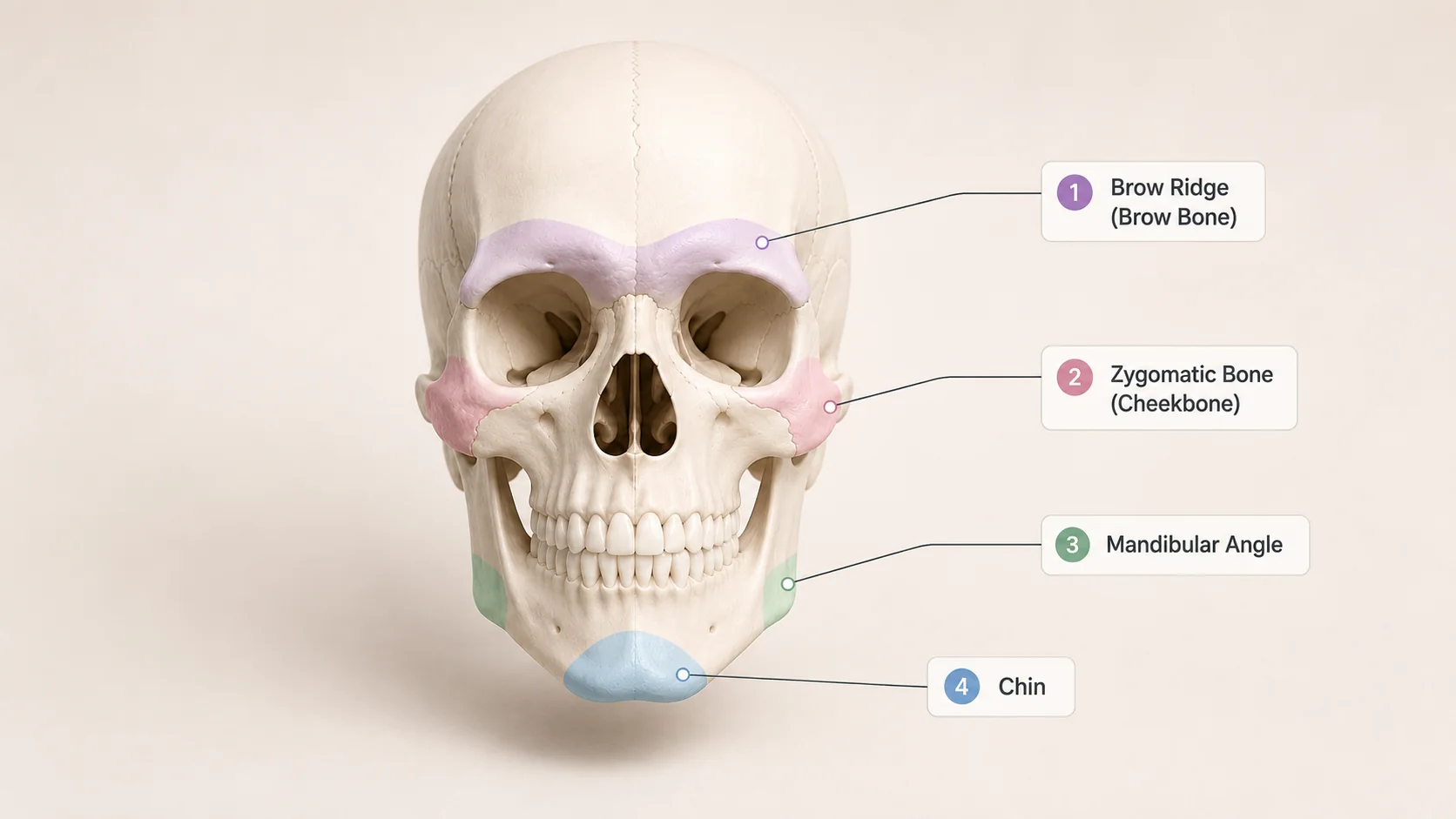
A facial feminization plan may involve the upper face, midface, lower face, or several areas together.
A complete assessment should consider the face as a continuous three-dimensional structure rather than a group of unrelated features.
Forehead and Brow Bone
The forehead and brow region can have a significant effect on facial gender perception.
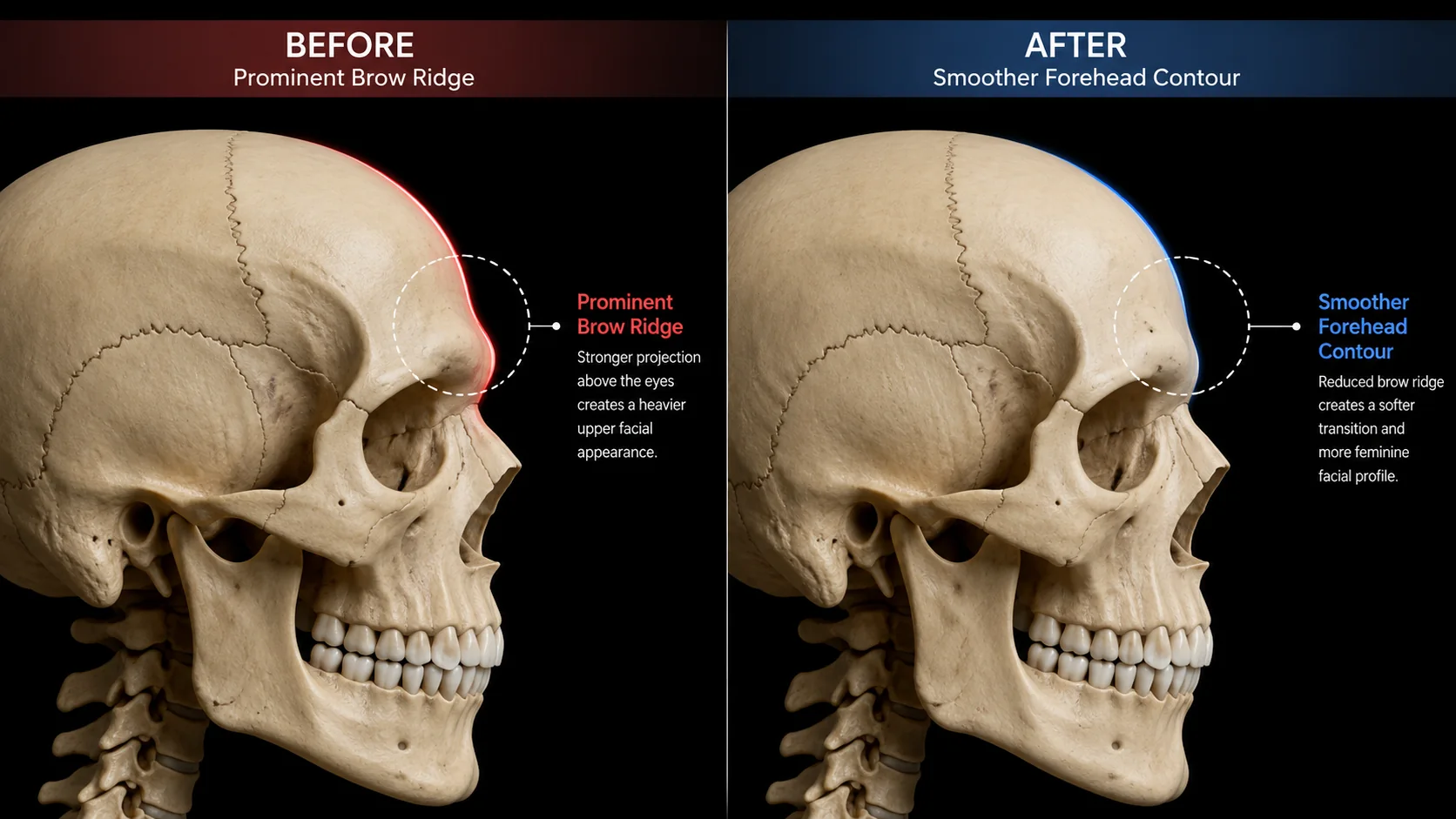
In some individuals, the brow ridge projects more strongly forward, creating deeper shadows around the eye area and a heavier upper facial appearance.
The forehead may also have a more pronounced slope or angular transition.
Forehead feminization may involve:
- Reducing brow bone prominence
- Smoothing the forehead contour
- Modifying the transition between the forehead and nose
- Refining the upper facial profile
The exact technique depends on the anatomy of the frontal bone and frontal sinus.
Some patients may require limited contouring, while others may need more extensive reconstruction.
The goal is not simply to flatten the forehead.
A natural result still requires appropriate curvature, projection, and harmony with the nose and orbital area.
Cheekbones and Midface
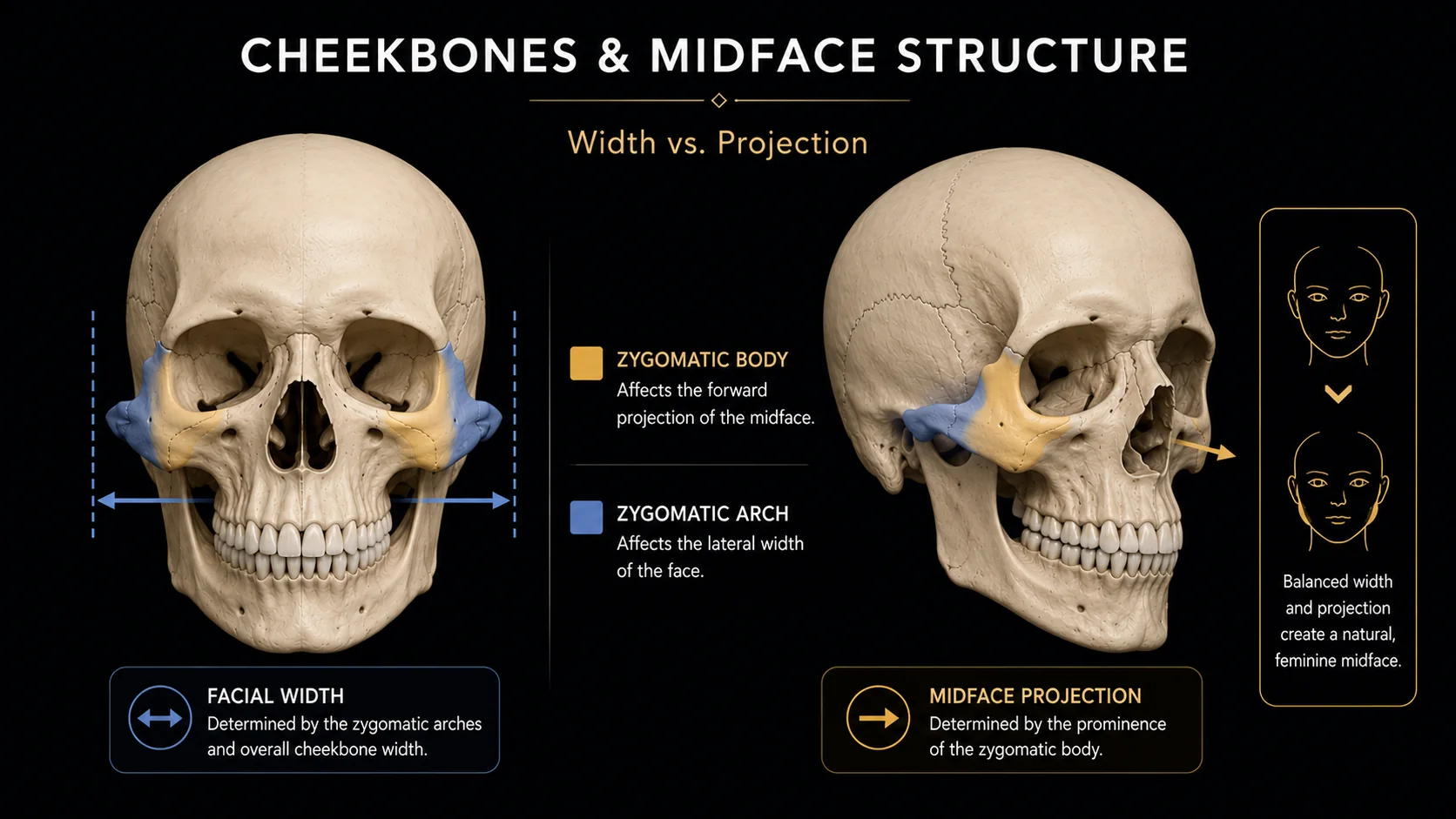
The cheekbones, or zygomatic bones, form an important part of the midface.
They influence both facial width and the way the upper and lower face transition into one another.
Cheekbone prominence can occur in different directions.
A patient may have:
- Strong lateral cheekbone width
- Strong forward projection
- Prominent zygomatic arches
- Asymmetric cheekbone structure
- A wide midface when viewed from the front
These are not all the same problem.
In some patients, lateral cheekbone prominence may be reduced through zygomatic contouring or repositioning.
However, facial feminization does not necessarily mean making the cheekbones as small as possible.
Appropriate anterior cheekbone projection can actually contribute to a youthful and feminine facial appearance.
The goal is therefore not maximum reduction, but better three-dimensional balance.
Jawline and Mandibular Angles
The lower jaw is one of the most important areas in facial contouring.
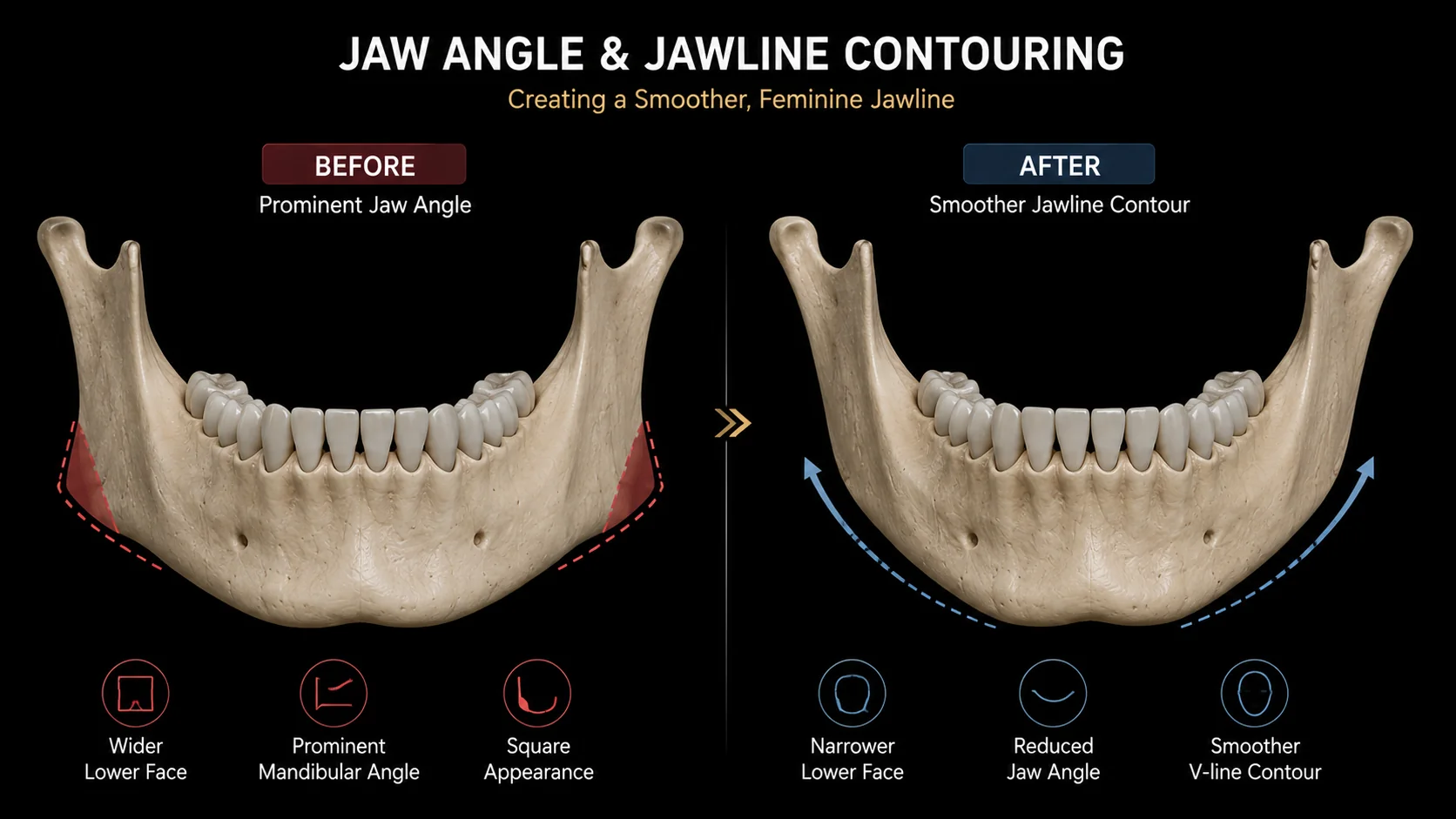
Prominent mandibular angles can make the lower face appear wider, stronger, or more square.
The mandibular angle is located toward the back of the lower jaw.
When it projects strongly outward, it can contribute to:
- A broad lower face
- A square facial outline
- Increased width from the front
- A heavier three-quarter profile
Mandibular angle reduction may be used to reduce this prominence.
However, effective lower-face contouring often requires more than simply removing the posterior angle.
The transition from the mandibular angle toward the chin is equally important.
If only the posterior angle is reduced, the remaining jaw body may still appear wide or irregular.
For selected patients, a longer and smoother contouring approach may help create a continuous transition from the back of the jaw toward the chin.
The objective should be a natural lower facial curve rather than an abruptly narrowed jaw.
Chin Shape and Lower-Face Balance
The chin plays a central role in lower facial shape.
Its appearance depends on:
- Width
- Vertical height
- Forward projection
- Shape
- Symmetry
- Relationship with the jawline
A broad or square chin can maintain a strong lower facial appearance even after jaw angle reduction.
For this reason, chin contouring is often considered together with mandibular contouring.
Depending on the anatomy, treatment may involve:
- Narrowing the chin
- Shortening the chin
- Increasing or decreasing projection
- Reshaping the lower border
- Repositioning the chin
However, a feminine chin does not necessarily mean an extremely narrow or pointed chin.
An overly small or sharp chin may create an unnatural appearance.
A balanced result should create a smooth transition between the jawline and the chin.
No.
This is one of the most important misunderstandings about facial feminization.
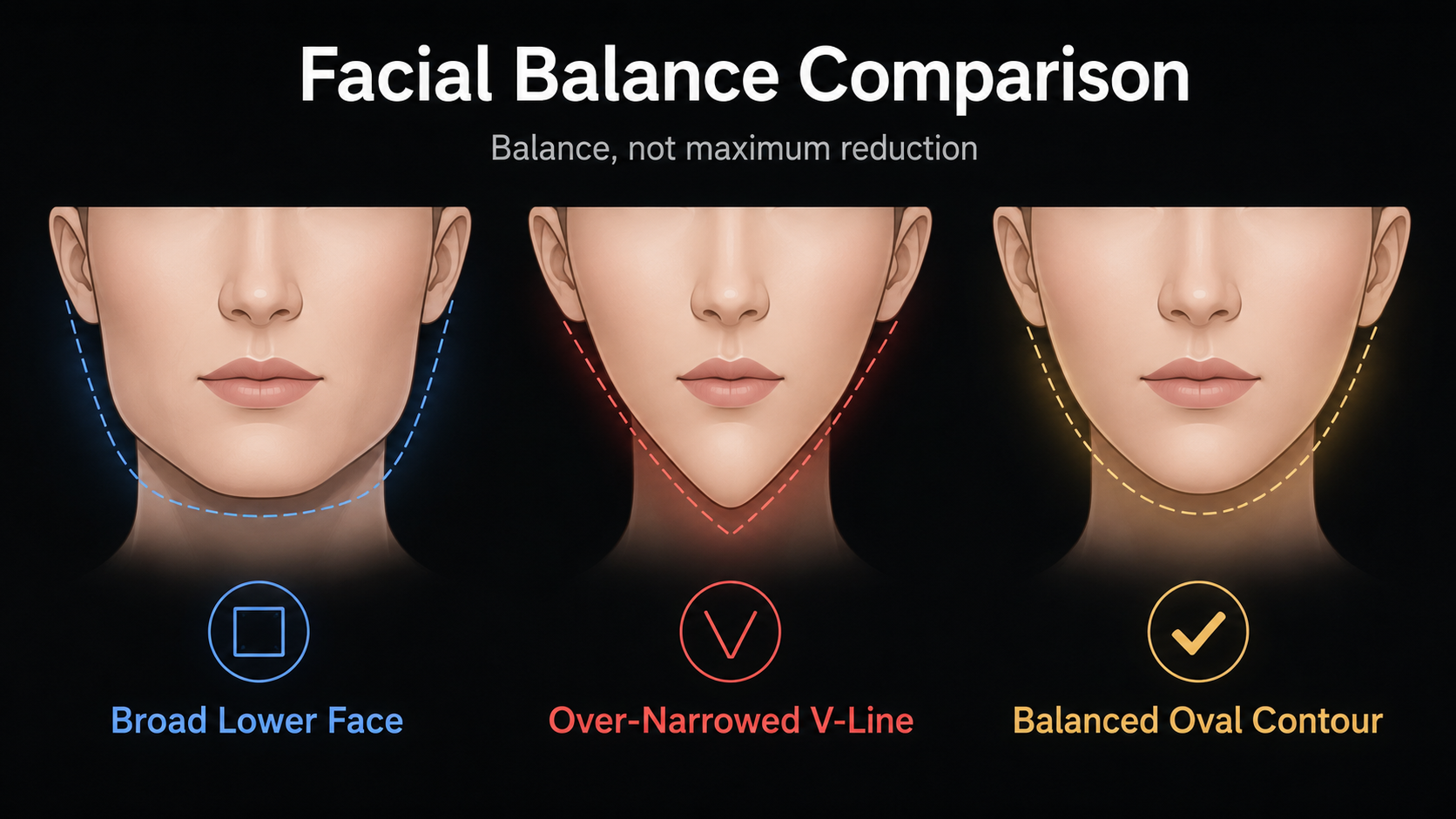
The goal of FFS is not simply to make every facial structure smaller.
Over-reduction can create new problems.
For example:
- An excessively narrow jaw can make the cheekbones appear too wide.
- Excessive cheekbone reduction can reduce natural facial support.
- An overly narrow chin can create an artificial V-shaped appearance.
- Excessive forehead reduction can make the profile look flat.
Good FFS planning therefore focuses on proportion rather than maximum reduction.
A balanced face depends on the relationship between the forehead, cheekbones, jawline, chin, and soft tissues.
In many cases, moderate changes across several areas can look more natural than aggressive reduction in one isolated area.
A good FFS plan begins with a detailed facial assessment.
The surgeon may evaluate:
- Facial width
- Facial height
- Facial symmetry
- Forehead shape
- Brow ridge prominence
- Cheekbone position
- Jaw width
- Mandibular contour
- Chin proportions
- Soft-tissue thickness
- Relationship between facial thirds
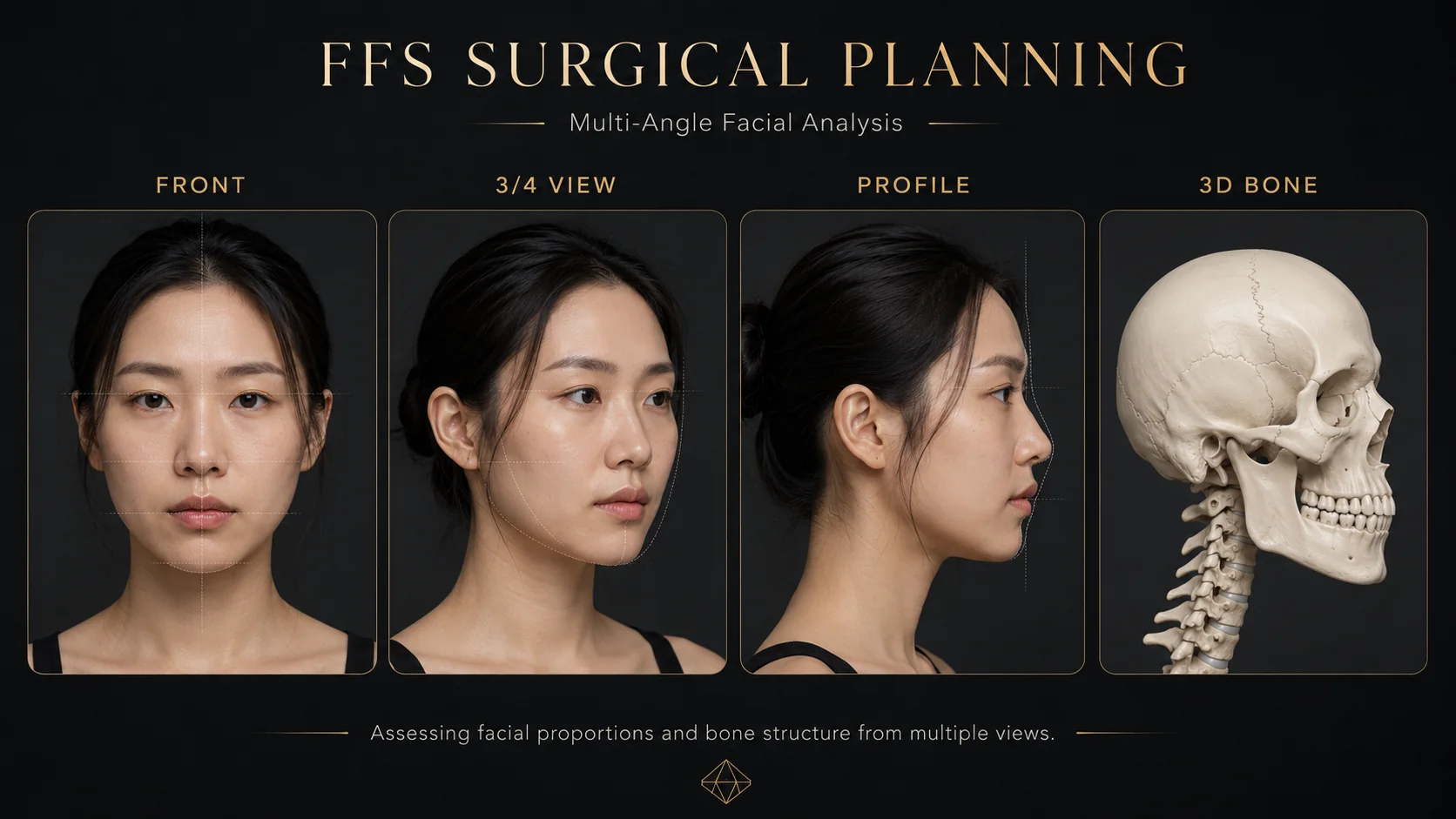
The face should be evaluated from several views.
Front View
The front view helps assess:
- Overall facial width
- Left-right symmetry
- Cheekbone width
- Jaw width
- Chin width
- Relationship between the midface and lower face
Three-Quarter View
The three-quarter view is particularly useful because it shows both width and projection.
Some structures may look relatively balanced from the front but appear much more prominent at an angle.
This is especially important when evaluating the cheekbones and mandibular angles.
Profile View
The profile helps assess:
- Forehead slope
- Brow bone projection
- Nasal profile
- Chin projection
- Jaw position
- Overall facial convexity
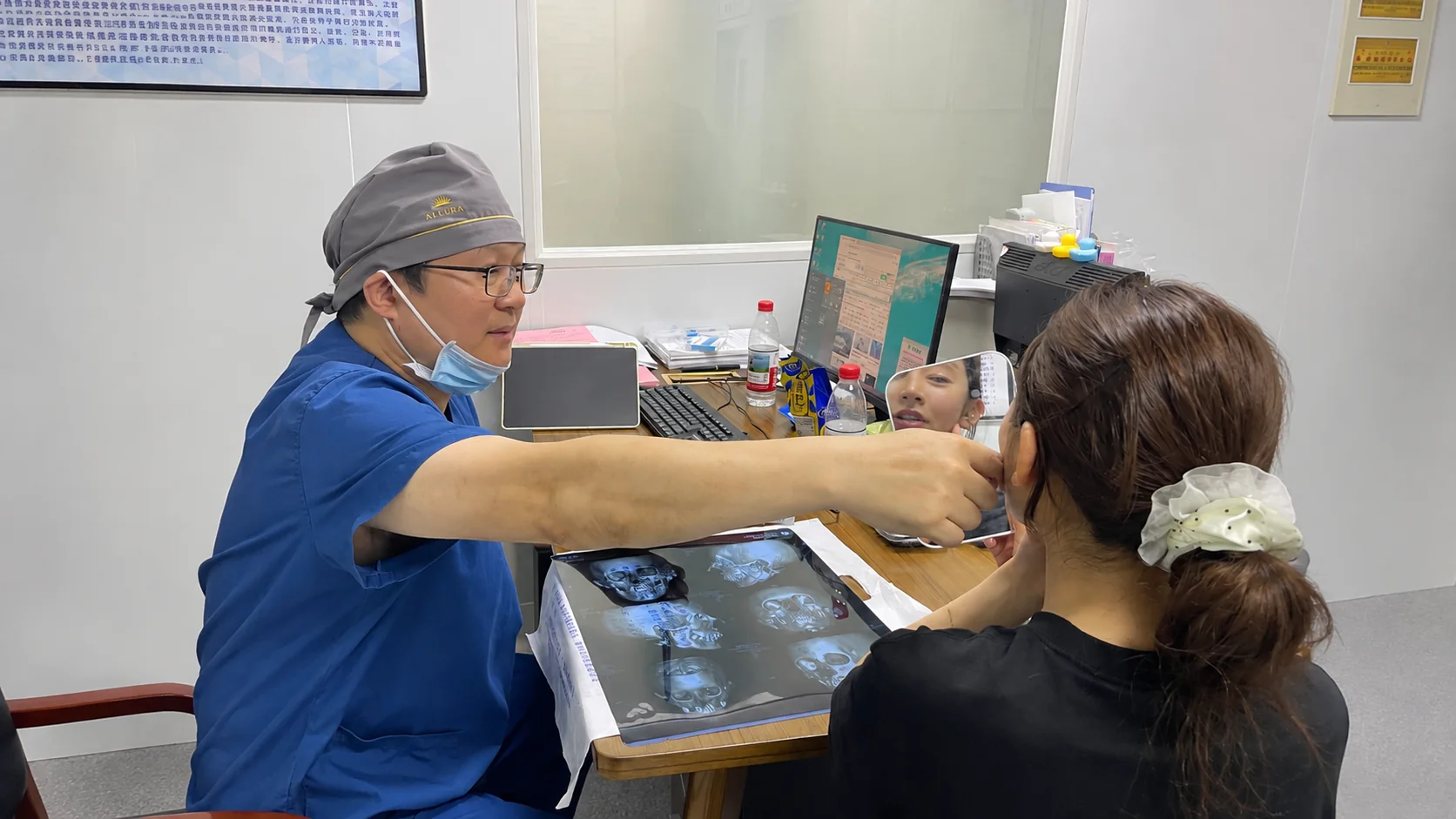
CT and Three-Dimensional Evaluation
For facial bone surgery, CT imaging may be used to understand the underlying skeletal anatomy more accurately.
Three-dimensional reconstruction can help evaluate:
- Bone thickness
- Frontal sinus anatomy
- Skeletal asymmetry
- Jaw shape
- Chin structure
- Zygomatic anatomy
- Position of important nerves
This allows surgical planning to be based on the actual skeletal structure rather than surface appearance alone.
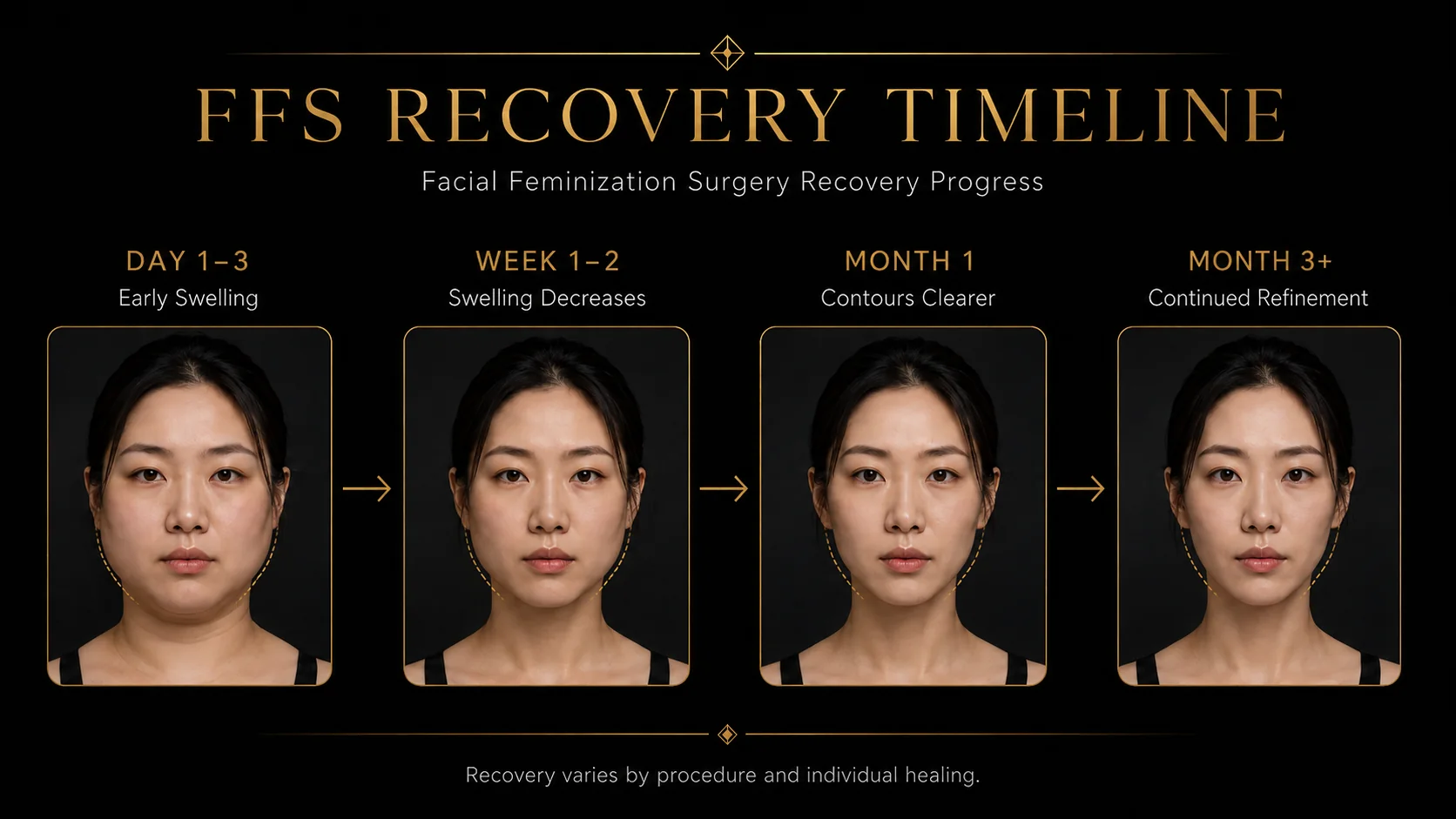
Recovery depends on the number and type of procedures performed.
Facial bone surgery usually causes swelling, and the facial appearance changes gradually as healing progresses.
During the first several days, patients may experience:
- Swelling
- Tightness
- Bruising
- Temporary numbness
- Discomfort
- Difficulty chewing after lower-face surgery
Early swelling generally improves over the following weeks.
However, subtle swelling may remain longer, especially after extensive facial bone procedures.
The soft tissues also need time to adapt to the new skeletal framework.
For this reason, the final facial contour should not be judged during the early recovery period.
The face often continues to refine over several months.